Why Horizontal Fencing Is Trending in Houston, TX
The shift toward horizontal fencing in Houston mirrors a broader design movement that has reshaped American residential architecture over the past decade. Modern and contemporary home styles — characterized by clean lines, minimalist ornamentation, and material contrast — are the fastest-growing segments of new home construction and renovation in Houston's urban core. The Heights, Montrose, Midtown, East End, and Midcentury-influenced neighborhoods throughout the inner loop have embraced horizontal fencing as the natural fence expression for this design language.
Horizontal boards running left-to-right create long visual lines that extend the eye along the fence length, making yards feel wider and more expansive. The same board that looks like a utilitarian wood privacy fence when installed vertically takes on an architectural, intentional quality when laid horizontally — even if the material, the height, and the wood species are identical. It's a geometry shift, not a material change, and the visual impact is disproportionate to the cost difference.
The style also works exceptionally well with complementary design elements: concrete planters along the fence base, ornamental grasses in front of the fence face, and LED uplighting that washes light downward from the fence top at night. These pairings are common in the Heights and Montrose neighborhoods where landscape design and fence design are considered together as one cohesive outdoor composition.
6 Horizontal Fence Design Ideas for Houston Homes
Modern Horizontal
Horizontal board fencing has surged in popularity — clean lines, contemporary aesthetic, pairs well with modern architecture.
Classic Privacy
6-ft board-on-board cedar is Houston's most popular backyard fence — complete privacy with a clean, finished look.
Ornamental Iron
Front yard ornamental iron creates curb appeal, defines your property, and satisfies most Houston HOA requirements.
Picket Fence
4-ft white picket fencing in vinyl or wood adds classic charm to front yards and defines garden borders.
Shadow Box
Shadow-box fence has alternating pickets on both sides — looks great from both the yard and the street.
Lattice Top
Add decorative lattice panels above a standard privacy fence for height, light filtration, and visual interest.
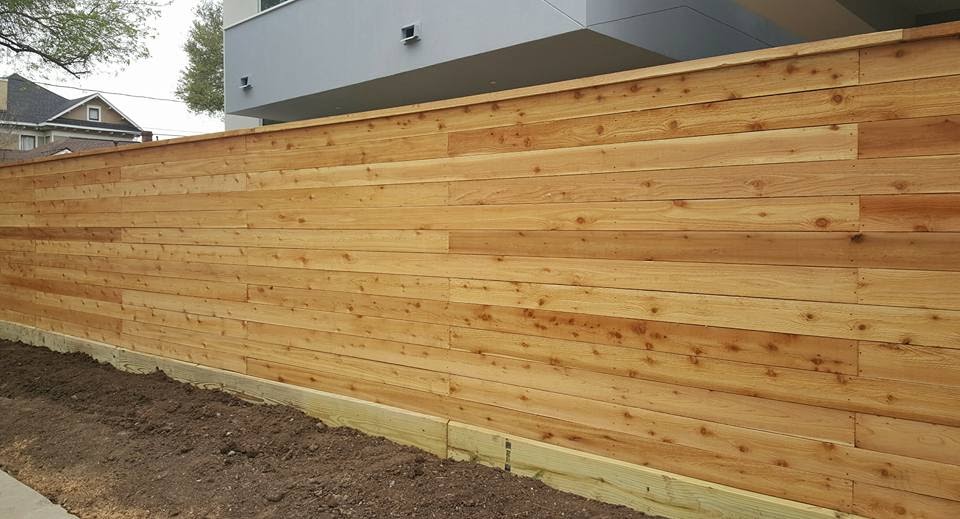
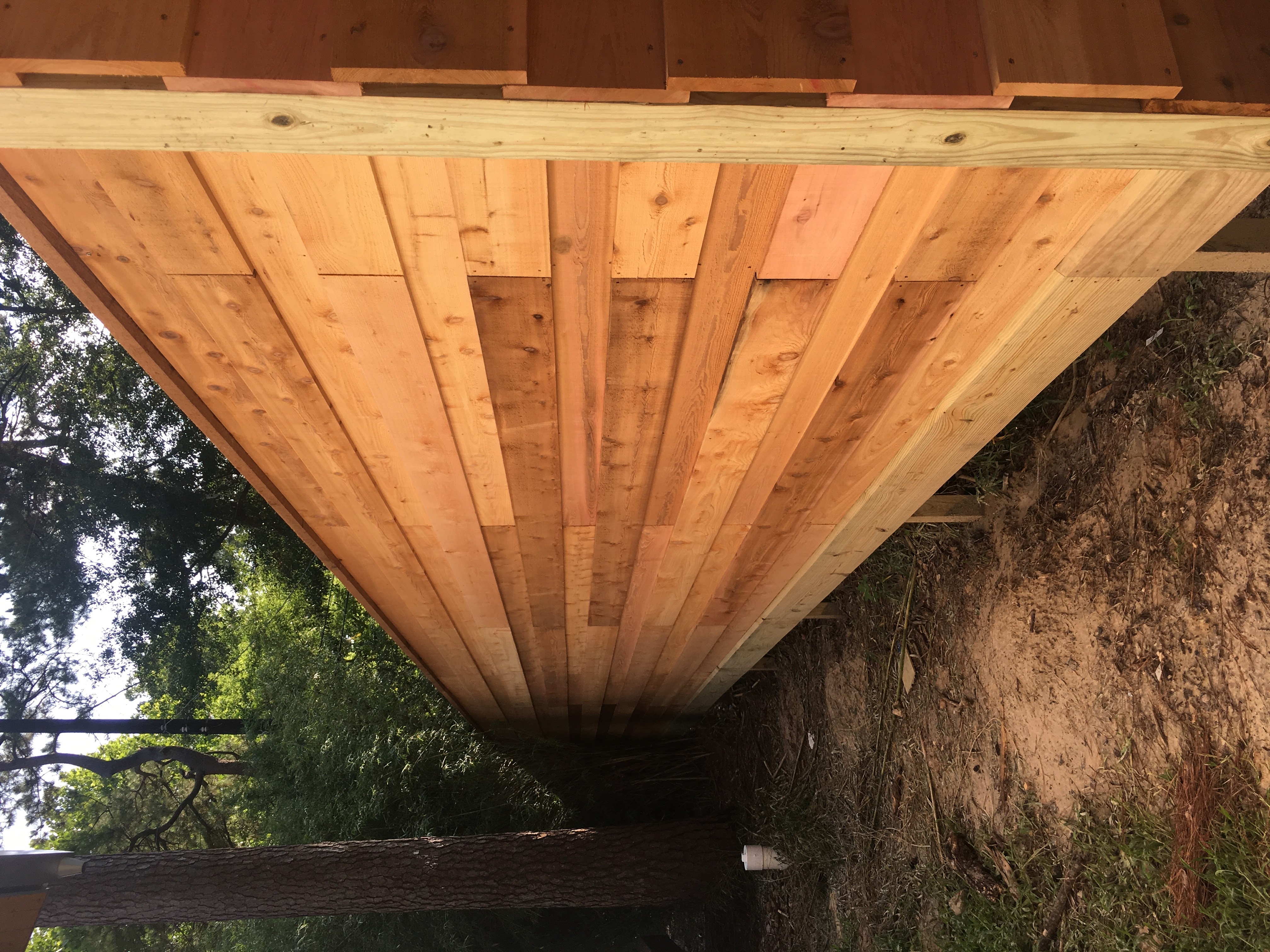
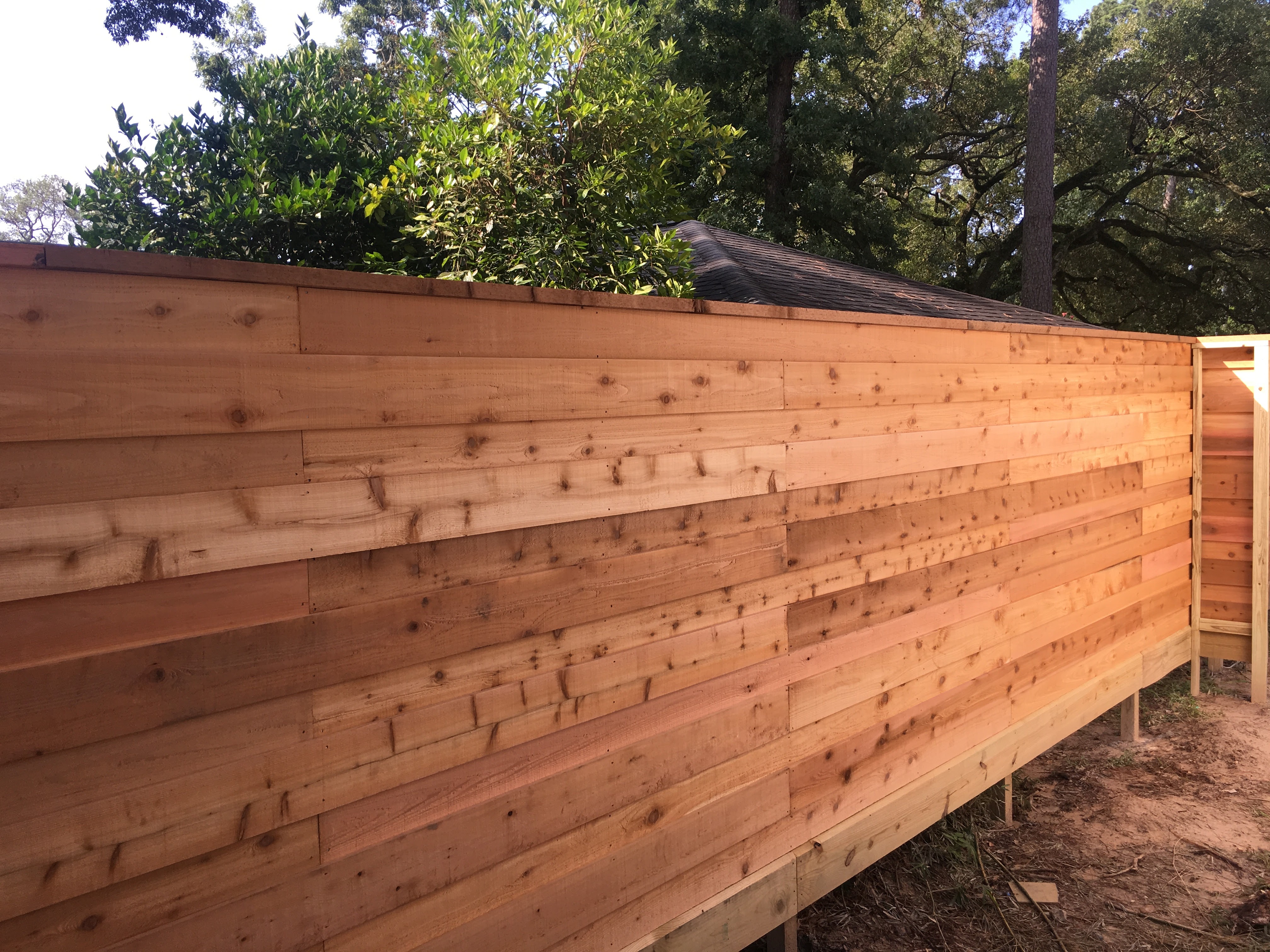
1. Tight Horizontal Cedar — Full Privacy, Maximum Warmth
Boards installed flush or with 1/4-inch expansion gaps create a full-privacy horizontal fence with the warm, natural look of cedar wood grain running in long, unbroken lines. From inside the yard, the horizontal pattern creates a sense of enclosure and calm — the fence reads more like a wall than a boundary. From the street, the long horizontal lines give the property a quietly sophisticated presence that standard vertical board-on-board privacy fence simply doesn't achieve.
Cedar is the right species for tight horizontal installation in Houston, TX. Its natural oils resist the moisture absorption that degrades faster-growing species in this climate. Board widths from 4 to 6 inches are most common — wider boards (6 inches) create a bold, graphic look; narrower boards (4 inches) create a finer, more refined pattern with more horizontal lines visible across the fence height. The surface left natural weathers to a distinguished silver-gray over two to three years; stained in warm cedar-tone or honey, it remains warm and fresh-looking for four to six years before restaining.
2. Spaced Horizontal Cedar — Airflow, Light, and Wind Performance
A 1-inch gap between horizontal boards creates what amounts to near-full privacy (sightlines are blocked from any normal viewing angle) while allowing air to pass through the fence — a meaningful functional advantage in Houston's humid summers and a genuine safety benefit during hurricane season. Solid horizontal fences bear nearly the same wind load as solid vertical fences; a spaced horizontal design allows wind to pass through and significantly reduces the load on posts during storm events.
The light pattern created by spaced horizontal boards is one of this design's most attractive qualities. Sunlight passing through the 1-inch gaps casts alternating bands of light and shadow across the ground and plantings inside the fence — a dynamic, changing pattern through the day that static solid fences cannot produce. At dusk with interior lighting, the effect reverses and the light streams outward through the gaps in warm striped patterns visible from the street. This design choice costs no more than tight installation and performs better in the Houston climate — it's typically the recommendation for any Houston homeowner choosing horizontal cedar for a backyard fence.
3. Horizontal Cedar with Black Steel Posts — The Premium Houston Look
This combination has become the signature premium horizontal fence aesthetic in Houston, TX. Natural cedar boards — either tight or with 1-inch spacing — are mounted to black powder-coated steel posts using concealed or visible mounting brackets. The posts are typically 3x3 or 4x4 square steel tube, set in concrete, spaced 6 to 8 feet apart. The cedar boards attach horizontally through the steel, with the post faces visible at intervals along the fence run.
The material contrast — warm natural wood grain against cold industrial matte black steel — is the visual centerpiece of this design. It simultaneously reads as rustic (the wood) and industrial-modern (the steel), which is precisely the tension that defines the modern farmhouse aesthetic currently dominant in Houston home design. The steel posts are also structurally superior to wood posts in Houston's clay soil, where seasonal expansion and contraction heave wood posts over time. On this design, the steel posts serve both aesthetic and structural purposes — a genuine value proposition that justifies the cost premium.
4. Dark-Stained Horizontal Fence — Bold, Contemporary Statement
Apply a deep espresso or charcoal stain to horizontal cedar and the fence becomes a design statement rather than a boundary. The dark color amplifies the horizontal lines visually — darker surfaces advance and recede in ways that light surfaces don't, giving the horizontal pattern a three-dimensional depth on bright Houston days. Against a white or cream home exterior, the contrast is dramatic. Against warm brick, it provides a rich foil. Against a dark exterior (deep gray, navy, black), it creates a tonal composition where fence and home merge visually.
Houston-specific maintenance note: dark stains on horizontal boards require more frequent maintenance than any other finish choice. Houston's UV intensity bleaches pigment faster than in most US markets, and horizontal boards are particularly vulnerable because water pools on their top surfaces and UV exposure on the horizontal face is more direct than on vertical boards. Expect to restain a dark horizontal fence every two to four years with quality UV-inhibiting stain versus every four to six years for a natural or light-toned cedar wood fence installation. The look is worth the maintenance commitment for homeowners who are genuinely invested in the design — but it's a commitment that should be made knowingly.
5. Composite Horizontal Planks — The No-Maintenance Alternative
Composite lumber (Trex, TimberTech, and similar brands) delivers the horizontal fence look in a material that doesn't rot, warp, check, fade significantly, or require any sealing, staining, or painting. Composite boards are manufactured from a blend of reclaimed wood fiber and recycled plastic — they're engineered to resist the moisture, UV, and insect pressures that degrade natural wood. In Houston's climate, where cedar requires periodic sealing and pine degrades rapidly, composite is a compelling choice for homeowners who want horizontal fencing without ongoing maintenance.
Modern composite profiles in earth tones (warm brown, weathered gray, cedar-look) are significantly more attractive than the early-generation composite decking products that looked conspicuously artificial. The edges are clean and consistent, the surface texture is convincingly wood-like, and the color is UV-stable for decades per manufacturer specifications. The material costs more upfront than cedar but eliminates the ongoing sealing and maintenance cost entirely. For a 15-year total cost of ownership comparison, composite often matches or beats cedar when maintenance savings are factored in.
6. Aluminum Horizontal Slat Fence — All-Metal Modern
Extruded aluminum horizontal slat fence panels are the industrial-modern end of the horizontal fence spectrum. Aluminum slats — typically 2 to 4 inches wide, in solid or slightly spaced configurations — are framed in aluminum posts and rails, powder-coated in matte black, charcoal, or bronze. The result is a fence that looks genuinely architectural: clean, precise, and contemporary in a way that wood cannot replicate regardless of the design.
For Houston homeowners near the Ship Channel, Galveston Bay, or League City's coastal area, aluminum is the material of choice because it is genuinely rust-proof — unlike steel, it cannot corrode even in salt-laden coastal air. It's also appropriate for commercial applications along Houston's commercial corridors where a modern, low-maintenance perimeter fence is required. The cost is higher than cedar horizontal but comparable to composite over a long time horizon given aluminum's indefinite service life with minimal maintenance.
Spacing Options and Privacy Levels
The gap between horizontal boards determines both the privacy level and the wind performance of the fence. Here's a practical guide:
- Flush / tight (0–1/4" gaps): 100% visual privacy. Maximum wind load on the fence (treat like a solid panel for storm planning). Best for enclosed backyards in densely packed neighborhoods.
- 1-inch gaps: Near-full privacy (sightlines blocked from any normal ground-level viewing angle). Good airflow. Reduced wind load vs. solid. Best balance of privacy and performance for most Houston backyards — this is the most commonly specified gap.
- 2-inch gaps: Semi-private. Adequate for obscuring general yard details from passing vehicles and distant sightlines. Poor for close neighbors. Better wind performance than tight. Popular for front yard applications where full privacy isn't the goal.
- 3+ inch gaps: Decorative and boundary-marking rather than privacy-providing. Excellent wind performance. Used primarily for front yard aesthetics, garden borders, and commercial decorative applications.
Houston-Specific Considerations for Horizontal Fencing
Sealing All Surfaces Before Installation
Water pools on horizontal surfaces rather than running off as it does on vertical boards. Unsealed top edges and exposed end grain absorb this standing water rapidly, leading to accelerated checking (cracking), warping, and eventually rot at those surfaces. This is why improperly built horizontal Western Red Cedar fences in Houston fail in 5 to 8 years when the same boards in a vertical fence would last 15 to 20 years.
This step adds modest cost but is not optional in Houston's wet climate. Any contractor who doesn't mention sealing horizontal boards before installation is telling you something important about their experience with this fence style in this region.
Wind Load in Hurricane Season
A tight horizontal cedar fence bears almost the same wind load as a solid vertical board-on-board fence — both are essentially solid panels. During Harvey (2017) and Beryl (2024), solid fences across Houston's suburbs failed at high rates as sustained winds and gusts applied full force against solid panels. For homeowners in exposed locations — larger lots with no wind-breaking structures, properties near open fields, coastal-adjacent areas — spaced horizontal design (1-inch gaps minimum) is the recommended configuration. The reduced wind load is not just a comfort consideration; it's the difference between a fence that survives a major storm and one that requires full replacement after it.
HOA Approval for Horizontal Fencing
Horizontal fencing is well-established in Houston's inner-loop neighborhoods where deed restrictions are minimal. In HOA-governed suburban communities, approval is less certain. Many traditional HOAs in Katy, Sugar Land's older sections, and Pearland's established neighborhoods have fence standards written before horizontal style became common — and some will decline applications for styles not enumerated in their approved list. Newer master-planned communities like Bridgeland (Cypress) are generally more open to horizontal fence designs as they've updated their design standards more recently. The Woodlands RDRC approves natural cedar in approved styles — horizontal cedar has been approved in some sections but requires individual review.
Always submit a full application to your HOA's architectural review committee, including a diagram showing board dimensions, spacing, post configuration, and stain/finish color, before ordering materials. This step adds two to six weeks to your project timeline but protects you from the significant cost and frustration of building a fence that gets ordered removed.